African Raptors

The online home of African Raptor interests

African Raptors header image 1

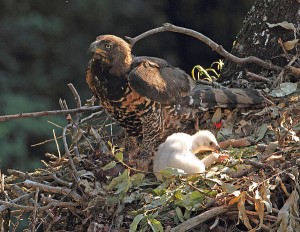
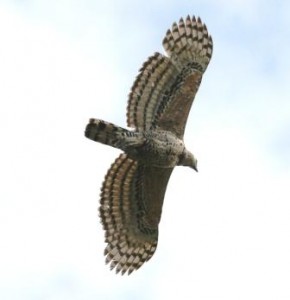
Red Buzzards still pose mystery in South Africa’s Cape Peninsula By Ann Koeslag

June 11th, 2009 · Discussion Forum


The Mysterious "Red Buzzard"

The Mysterious "Red Buzzard"

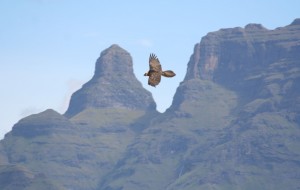
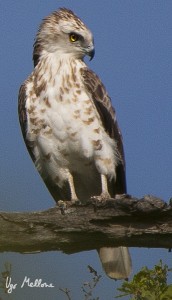
The eastern slopes of Table Mountain, South Africa, were covered with pine trees until the widespread fires of summer 1999-2000. Though the Constantiaberg was hardly affected by the fires (while other areas were completely denuded of trees), there has been a determined deforestation effort in the area, taking the form of harvesting of the pine trees in the interests of alien clearing. An offshoot of the Black Sparrowhawk Project (about 30 prs of Black Sparrs use the plantations  for nesting in and around the mountain) has been the monitoring of other tree-nesting raptors. What we found was a mystery species of buzzard nesting in the plantations on the Constantiaberg and elsewhere in the Western Cape. [Read more →]

→ 1 CommentTags:

Mackinder’s Eagle Owls in Kenya by Darcy Ogada

May 18th, 2009 · Raptor Research

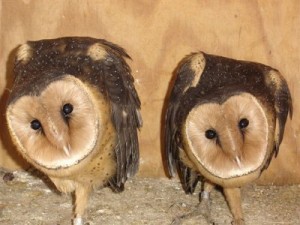
Mackinder's Eagle Owl. Photo by Simon Thomsett

Mackinder's Eagle Owl. Photo by Simon Thomsett

A population of Mackinder’s eagle owls in central Kenya has been the focus of ecological research in since June 2004.  Darcy Ogada of the National Museums of Kenya and Paul Muriithi have been studying this population of approximately 16 pairs to determine the impacts of farming practices on the ecology and conservation of the owls. The owls’ nest and roost on cliffs adjacent to small farms in the lower reaches of the Aberdare Mountains.  The owls are also a draw for bird tourists and the income generated from this supports individual farmers and community projects.  [Read more →]

→ 10 CommentsTags:

Satellite-tracking Black Harriers in South Africa (Update March 2009) By Rob Simmons

May 4th, 2009 · Raptor Research


Motlanthe provisioning food to dependent young sporting his satellite transmitter in the West Coast N.P. (photo: M.Anderson)

Motlanthe provisioning food to dependent young sporting his satellite transmitter in the West Coast N.P. (photo: M.Anderson)

A pilot study of the dispersal and behaviour of satellite-tagged Black Harriers Circus maurus was forged between Natural Research and Rob Simmons of the FitzPatrick Institute, University of Cape Town in 2008. Black Harriers are globally Vulnerable species with an estimated population of only 1000-2000 birds. Their breeding ecology and threats have been intensively studied in a 10-year programme run by Simmons and Andrew Jenkins, with their students focussing on the effects of habitat fragmentation and the utility of Black Harrier as indicators of biodiversity in the global biodiversity hotspot in the Western Cape of South Africa. [Read more →]

→ 3 CommentsTags:

Effect of human activities on scavenger guild structure and function in East Africa. A proposal by Corinne Kendall

May 1st, 2009 · Raptor Research


Ruppell's Vulture in Hell's Gate National Park

Ruppell's Vulture in Hell's Gate National Park

The primary objective of this project will be to understand how human activities, such as land use changes and poisoning, alter scavenger guild diversity, structure, and function. Research for this study will compare scavenger community structure and function across several gradients of land use within and outside of Masai Mara National Reserve, Kenya. I will address four complementary questions about the scavenger community by assessing differences in community structure and function within the protected area and around its borders. [Read more →]

→ No CommentsTags:

Standardizing Raptor Road Surveys in Africa

January 30th, 2009 · Discussion Forum


Ruppell's Vulture in Hell's Gate Kenya

Ruppell's Vulture in Hell's Gate Kenya

I have set up this post primarily for the benefit of those who would like to contribute toward the above discussion. Raptor road surveys are conducted throughout the world. It makes sense to standardize a cost-efficient system where data are collected with the minimum of effort. Simon Thomsett and I have been collecting raptor road data for many years. Basically we start at a set point, note down weather conditions, we zero in on the odometer and drive at between 50 and 60 km/h (naturally we do slow down when we are in protected areas). [Read more →]

→ No CommentsTags:

Montagu’s Harrier research in the Sahel

January 16th, 2009 · Raptor Research


Harrier in the dust

Harrier in the dust

Below is an exciting account of the work conducted on Montagu’s Harriers in the Sahel by the Dutch Montagu’s Harrier Foundation. Special thanks goes to Christine Trierweiler for providing the information and photographs. 

Aims of our Montagu’s Harrier work in the Sahel

We started our work in January-February 2006. Our aims are:

a) to collect information on distribution, abundance, habitat use, behaviour, diet, and prey abundance of Montagu’s Harriers in their W-African winter quarters, and threats to these, so that protection strategies for this species in Africa can be improved. [Read more →]

→ 1 CommentTags:

Potential decline of large raptors as a consequence of the commercial trade in bushmeat in the Ebo forest, Cameroon

January 16th, 2009 · Threats to Raptors


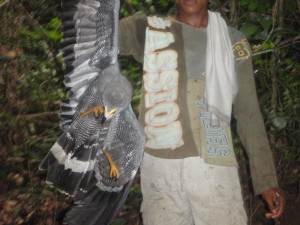
Ex-hunter (now Ebo Forest Research Project field assistant), Zacharie Bekokon, demonstrates how to imitate a crowned eagle call with a modified shotgun cartridge.

Ex-hunter (now Ebo Forest Research Project field assistant), Zacharie Bekokon, demonstrates how to imitate a crowned eagle call with a modified shotgun cartridge.

The Ebo forest in southwestern Cameroon covers over 1500km2 of mountainous mixed evergreen and deciduous forest and basalt outcrops. The challenging terrain has limited the extent of both timber exploitation and, until recently, the worst ravages of the commercial trade in bushmeat.  Consequently, the forest retains a relatively intact fauna. [Read more →]

→ No CommentsTags:

What to do with captive bred Taita Falcons?

January 16th, 2009 · Captive Breeding and Restoration


Adult captive bred female Taita Falcon (Falco fasciinucha) defends her male offspring (F2). He fledged a day later (1/12/2008).

Adult captive bred female Taita Falcon (Falco fasciinucha) defends her male offspring (F2). He fledged a day later (1/12/2008).

Unexpected breeding success from a pair of captive Taita Falcons (Falco fasciinucha) leads me to contemplate the fate of this offspring.  The aim of the Zimbabwe Falconers’ Club (Z.F.C.) Taita Falcon breeding project was to establish a captive population from which to propagate the species and ultimately release Taita Falcons to the wild (Hartley, 2002). 

Although there has been some success, the program has bred 15 offspring from 10 pairs; the Taita Falcon has proven to be a poor candidate for captive propagation.  While Taitas are delicate and difficult to breed, the main limitation is their low fecundity. This species seldom re-lays eggs in the event of failure, a shortcoming that restricts productivity as breeding is limited to one attempt per year. [Read more →]

→ 3 CommentsTags:

African Raptor Expedition

November 20th, 2008 · Raptor Research

Simon Thomsett and Laila Bahaa-el-din are embarking on an expedition around Africa and its islands to monitor raptor populations on the continent. Their aims are to observe, collect data on and photograph all diurnal resident and migratory species. They also have as main objectives to meet local experts and raise awareness. They will write a regular blog at http://simonthomsett.wildlifedirect.org as well as publish in popular and scientific journals. On conclusion of the trip, they hope to produce a book on the diurnal raptor species of Africa. This they plan to do in partnership with individuals who study particular species around Africa. [Read more →]

→ No CommentsTags:

First satellite tag for African raptor (Rob Simmons)

November 19th, 2008 · Raptor Research

Satellite tagged Black Harrier

Satellite tagged Black Harrier

The exciting news is that the first African harrier has been successfully satellite tagged in South Africa.
The tiny (12.5g) satellite tags I have for following Black Harriers was charged up in early October 2008 and the first one attached to a breeding male in the West Coast National Park, South Africa on 11 October with the help of Phoebe Barnard and Esme Beamish. [Read more →]

→ 2 CommentsTags: