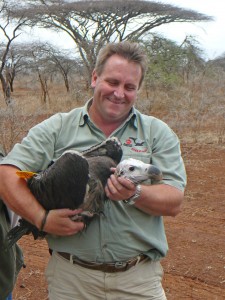
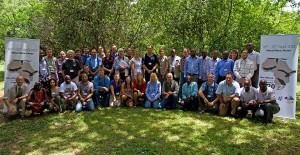
It was quite a frantic week planning ahead for the 3rd Vulture Workshop (the second in the Masai Mara) funded by The Peregrine Fund, which took place at Basecamp Explorer in the heart of the Masai Mara National Reserve in Kenya. The Basecamp Foundation and the Explorer Camp were extremely generous to provide subsidized accommodation while Vintage Africa provided a vehicle for participants attending from Nairobi (National Museums of Kenya, Kenya Wildlife Service, and Nature Kenya’s Raptor Working Group) and neighboring Masai villages. The Masai Mara National Reserve provided free entry to workshop participants. [Read more →]
Vulture Workshop in the Masai Mara National Reserve – by Munir Virani
May 11th, 2010 · African Raptor News
→ 1 CommentTags:
Conservation of the Bearded Vulture Gypaetus barbatus meridionalis. By Sonja Krüger
April 19th, 2010 · Raptor Research
Introduction
The Bearded Vulture is listed as endangered in the Southern African Red Data Book due to its small and declining population size, restricted range, range contraction, and the susceptibility to several threats in Lesotho and South Africa (BirdLife, 2004). Its red data status and the lack of data on current population size lead to a monitoring programme being implemented in 2000 by Ezemvelo KwaZulu-Natal Wildlife to determine the number of breeding pairs in the KwaZulu-Natal province of South Africa. [Read more →]
→ No CommentsTags:
New insights on “ecological barriers” in the migration pattern of the Eleonora’s Falcon
March 12th, 2010 · Raptor Research
We examined the connection between landscape characteristics and behaviour of a long-distance migratory raptor, the Eleonora’s falcon. Our main goal was to test whether long-distance migratory birds adjust their migration programme according to the different characteristics of the habitats crossed during the journey with special emphasis in the so-called ‘‘ecological barriers’’, inhospitable environments where the opportunities to fulfil energy requirements are low or absent and environmental factors could be extremely severe. To this end, 11 Eleonora’s falcons were tracked by satellite telemetry in [Read more →]
→ 1 CommentTags:
Ecological implications of vulture extinction on scavengers and disease transmission Darcy Ogada
February 27th, 2010 · Raptor Research
Reports of vulture declines have been numerous over the past decade. From southeast Asia to West Africa, vultures are declining at alarming rates, making them the most threatened functional group of birds. Due to their huge ranges, even relatively pristine areas in Kenya have seen large declines in vulture numbers.
Scavengers, especially vultures, provide one of the most important yet under-appreciated ecosystem services of any avian group. Because they feed by scavenging, vultures are highly specialized to rapidly dispose of large carcasses, thus playing a critical role in nutrient cycling, leading other scavengers to carcasses and reducing the risk of contamination by pathogens by quickly consuming decomposing carcasses. Despite the rate at which vultures are declining, little is known about the potential consequences of the widespread disappearance of these scavenging birds on other scavengers and rates of disease transmission at carcasses. [Read more →]
→ 1 CommentTags:
African Fish Eagles at Lake Naivasha: Using an apex predator to determine the effect of human activity on a lake ecosystem. Shiv Kapila
January 11th, 2010 · Raptor Research
The African Fish Eagles at Lake Naivasha have been studied for over 40 years, firstly by the late Leslie Brown, and more recently, by raptor biologists from The Peregrine Fund, Cambridge University, The University of Leicester and The Earthwatch Programme. I first joined this research programme for my Masters Degree dissertation six months ago and now, with support from The Peregrine Fund and the National Museums of Kenya, I am aiming to build on current data. [Read more →]
→ 1 CommentTags:
More blood from the stone – A report on Taita Falcon Survey by Andrew Jenkins
November 20th, 2009 · Uncategorized
The 2nd SA Taita Falcon survey

Wading through the river
In September 2006, a bunch of unwitting raptor biologists and enthusiasts got together at Dave Rushworth’s bush lodge Trackers just outside Hoedspruit, to commence a two-week long search of the surrounding mountains for the elusive Taita Falcon Falco fasciinucha (see Africa: Birds & Birding 12 (3): 35-37). Our aim back then was to add to the two known Taita nest sites in South Africa, both of which were situated on the northeastern Drakensberg escarpment, and to derive a more informed estimate of the national population of this hyper-rare, cliff-loving species. After heaving and thrashing and bashing and sweating and waiting and waiting and waiting… at most of the best rock faces in the region, we came away with two more nest sites, a deal of cuts, bumps and bruises, and the great satisfaction of having doubled the known population of Taita Falcons in South Africa. [Read more →]
→ 1 CommentTags:
Currents research on raptors in Madagascar by Lily de Roland Arison
October 1st, 2009 · Raptor Research

Madagascar Serpent Eagle Photo by Lily De Roland Arison
Madagascar, the fourth largest island in the world and 250 km east of Africa, has 23 species of raptors of which 17 and 6 are diurnal and nocturnal species, respectively. Of these 23 species, 13 are endemic to the island. Since the installation of The Peregrine Fund’s Madagascar Project in 1990, two endangered species were rediscovered: the Madagascar Serpent-eagle Eutriorchis astur and the Madagascar Red Owl Tyto soumagnei.
The Peregrine Fund’s Madagascar Project is currently and continues to conduct research and conservation on raptors with a focus on three endangered and threaten species: Madagascar Fish Eagle, Madagascar Serpent-eagle and Madagascar Red Owl. Below describes some of the research and highlights on these species from previous years and in 2008.
Madagascar Fish Eagle Haliaeetus vociferoides
We have monitored Madagascar Fish Eagles at two sites on the west coast of Madagascar. The first site is the Manambolomaty Lakes Complex which has been monitored since 1990 and with the highest concentration of nesting fish eagles in western Madagascar and the second site is in the [Read more →]
→ 1 CommentTags:
Is the Amur Falcon endangered? News from the Migrating Kestrel Project
August 5th, 2009 · Discussion Forum

Female Lesser Kestrel. Photo by Mark Anderson
The decline of Lesser Kestrel (Falco naumanni) population was brought to the attention of the raptor world in the early 1990s. Information available showed declines of around 46% since the 1950s in their breeding grounds and of around 25% in their wintering areas. Very little information was available at the time on the numbers and biology of these birds from their wintering grounds. The Migrating Kestrel Project (MKP) was established in 1995 by the Endangered Wildlife Trust specifically to address theses issues in their wintering grounds. [Read more →]
→ 2 CommentsTags:
Update from The African Raptor Expedition by Simon Thomsett and Laila Baha-el-Din
July 23rd, 2009 · Raptor Research

The African Raptor Expedition mobile
(Part I) Kenya to Botswana
We left Nairobi on February 15th and after spending a few days in the Masai Mara, we drove into Tanzania where we found large herds of wildebeests calving in the southern part of the Serengeti. With them, we found large numbers of vultures feeding on the calves that didn’t make it. We were driving southward along the Pare Mountains at dusk when we spotted a Taita Falcon hunting swifts. Still further south in Mikumi National Park, we saw our first and last Dickinson’s Kestrels of the trip and in Ruaha National Park, large numbers of Eurasian Hobbies were making the most of the rain and the termites that came with it. [Read more →]
→ 1 CommentTags:
Some thoughts on the unusual buzzards in the south Cape area – William S. Clark
July 1st, 2009 · Discussion Forum
A few years ago Odette Curtis sent me some photos taken by Ann Koeslag of unusually plumaged breeding buzzards in the Tokai forest. I told her that the female looked like a rufous-morph Steppe Buzzard. I still feel that way. I visited the area in early June 2008 with Ann to look at the nesting area of another unusual buzzard. She showed me the 2007 nest. An adult buzzard gave alarm calls at us (it probably recognized Ann) as we approached the nest and flew away. Farther away from the nest, another buzzard also gave alarm calls. Both adults flew together up the hill side. [Read more →]
→ 1 CommentTags: